Posts

Showing posts with the label Network Science

Analysis and Research trends using Word Co-occurrence Network
Image
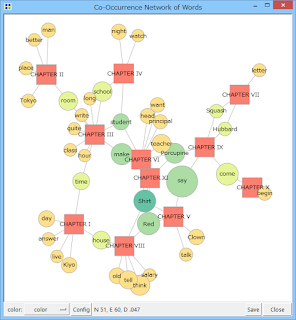
Co-occurrence networks   are basically used to provide and give a graphic visualization of potential relationships between people, community, organizations, concepts or other entities represented within the form of written material. The generation and visualization of   co-occurrence   networks has become practical with the advent of electronically stored and save the text amenable to   text mining . By way of definition, co-occurrence networks are the collective interconnection of terms based on their paired presence within a specified unit of text. Networks are generated by connecting pairs of terms using a set of criteria defining co-occurrence. For example, terms A and B may be said to “co-occur” if they both appear in a particular article. Another article may contain terms B and C. Linking A to B and B to C creates a co-occurrence network of these three terms. Rules to define co-occurrence within a   text corpus   can be set according to desired cr...

Statistics and Graphical Models in Data Science

Image
Statistics: For any aspiring data scientist, I would highly recommend   learning statistics with a heavy focus on coding up examples, preferably in Python or R. Mostly favorite series is the   Statistical Learning series. The SL Series is a   great primer on statistical modeling / machine learning with applications in R.(Reference by qoura.com) ·         Crucial component: Statistics is a crucial component of data science. At Twitch, The Professional data science team brings together three things: the first is statistics, second is  programming, and  third last is product knowledge. And we would never hire someone who wasn’t strong in stats. You can be a great programmer, but if you don’t know what Byes Rule is, then we have an engineering department I can point you to.” The origin in statistics is mostly undeniable. ·         Programming: Python:   Python is a mostly...

Data Extraction from Social Media Websites

There are ample of ways to extract data from Twitter because it is available in public domain. The implementation code and procedure to extract data from twitter has been explained in detail here . Moreover, data can be extracted from Meetup.com as explained . These implementations have been performed in Python language.  As per analysis, popular profiles have been obtained using the same code of Python. Such analysis can be carried out for both commercial marketing purpose and ordinary audience surfing purpose. This can help to serve community in better ways. Other source of standard dataset for testing Twitter analysis are as follows: http://socialcomputing.asu.edu/uploads/1296759055/Twitter-dataset.zip https://ia800501.us.archive.org/32/items/twitter_cikm_2010/twitter_cikm_2010.zip http://socialsensor.eu/results/datasets/72-twitter-tdt-dataset http://snap.stanford.edu/data http://ipv6.nlsde.buaa.edu.cn/zhaojichang/paper/wntm.rar http://mklab.iti.gr/files/eve...

Network Science for Social Media

Network Science is another upcoming field of research in social media analytic. In this, for instance, user profiles are treated as nodes and interlinking is framed among them. Based on this interlinking, different analysis are made. These analysis may include information diffusion among networks, coalition among networks, flooding of information or forest fires among nodes and much more. These problem domains are used when brand affinity or node popularity is required to be checked. There are further two types of nodes namely core node and periphery nodes. Core nodes are those nodes which are linked to many other nodes but periphery nodes are less popular nodes. Thus, core nodes can be the major source for information diffusion. Moreover, there is lot of concern for time frame and speed issues for interaction among nodes. Replication of data may lead to low accuracy and decrease in speed whereas one to one transmission may lead to increase in time. These factors should be ma...