Posts

Showing posts with the label Social Network Analysis

Analysis and Research trends using Word Co-occurrence Network
Image
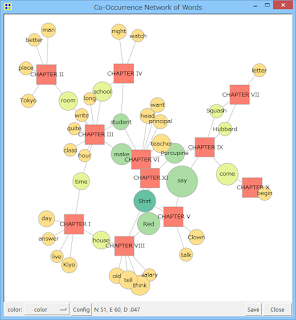
Co-occurrence networks   are basically used to provide and give a graphic visualization of potential relationships between people, community, organizations, concepts or other entities represented within the form of written material. The generation and visualization of   co-occurrence   networks has become practical with the advent of electronically stored and save the text amenable to   text mining . By way of definition, co-occurrence networks are the collective interconnection of terms based on their paired presence within a specified unit of text. Networks are generated by connecting pairs of terms using a set of criteria defining co-occurrence. For example, terms A and B may be said to “co-occur” if they both appear in a particular article. Another article may contain terms B and C. Linking A to B and B to C creates a co-occurrence network of these three terms. Rules to define co-occurrence within a   text corpus   can be set according to desired cr...

Statistics and Graphical Models in Data Science

Image
Statistics: For any aspiring data scientist, I would highly recommend   learning statistics with a heavy focus on coding up examples, preferably in Python or R. Mostly favorite series is the   Statistical Learning series. The SL Series is a   great primer on statistical modeling / machine learning with applications in R.(Reference by qoura.com) ·         Crucial component: Statistics is a crucial component of data science. At Twitch, The Professional data science team brings together three things: the first is statistics, second is  programming, and  third last is product knowledge. And we would never hire someone who wasn’t strong in stats. You can be a great programmer, but if you don’t know what Byes Rule is, then we have an engineering department I can point you to.” The origin in statistics is mostly undeniable. ·         Programming: Python:   Python is a mostly...

Analysis using social network with Twitter

Twitter is one of the most easily available platform for such analysis. There are ample of things which can be studied, analysed and predict for future. For instance, understanding the patterns of communication among twitter users, linking between tweets, user - user similarity etc. These needs to be studied within twitter data itself. Haewoon Kwaak, Changhyun Lee, Hosung Park, Sue Moon, "What is Twitter, a Social Network or a News Media?", WWW 2010, April 26–30, 2010, Raleigh, North Carolina, USA has been the most popular study. This is the base for understanding of such analysis. Removing spam tweets, user profiling, trending tweets are some of the key factors which can be referred as a good study from this article. Many of the academic researchers and practitioners are working on this. It can be useful in future if considerable amount of work is done to automate some business units using social media data.

Network Science for Social Media

Network Science is another upcoming field of research in social media analytic. In this, for instance, user profiles are treated as nodes and interlinking is framed among them. Based on this interlinking, different analysis are made. These analysis may include information diffusion among networks, coalition among networks, flooding of information or forest fires among nodes and much more. These problem domains are used when brand affinity or node popularity is required to be checked. There are further two types of nodes namely core node and periphery nodes. Core nodes are those nodes which are linked to many other nodes but periphery nodes are less popular nodes. Thus, core nodes can be the major source for information diffusion. Moreover, there is lot of concern for time frame and speed issues for interaction among nodes. Replication of data may lead to low accuracy and decrease in speed whereas one to one transmission may lead to increase in time. These factors should be ma...

Networks and Games

"Networks and Games" workshop held at IIT Ropar was a great platform to share knowledge regarding network sciences and game theory. This was held from 7th of December 2015 to 9th of December 2015. There is considerable amount of work which is being carried on nodes homophily, cascading information, coalition etc. These concepts are widely being practices by academic researchers and practitioners. Moreover, nash equilibrium, 80:20 rule, utility models are few other major areas of research. Making analysis by extracting information from network among nodes, predicting information about what is going to get happen in future are good field of related research. This work is related to Network theory and game theory. However, there are many other workshops and conferences related to similar areas which are happening around the world. Data science is the emerging area of research.

The basics of Social Network Analysis

Social Media Analysis is known better by Linton C. Freeman who developed fundamentals of social media analysis in 2004. It is multi-disciplinary. Basic Vocabulary: Node (Vertex) Link (Edge) Node is a person's profile id/ wikipedia article/ email address/ twitter name/ facebook name etc. Link is from one node to another Link can be directed or undirected. In social media analysis, we use only directed link. Two-way links are said to be reciprocated links One-way link are called unreciprocated links Degree is the number of ties to other nodes/ actors in the network. Indegree: Count of number of nodes connected to the nodes (Popularity). Outdegree: Count of number of ties that a node directs to others. (Gregariousness). Density: How close the edges are towards each other. More the number of links, more is the density.  Graph with few edges is called sparse graph Bridges is the edge which if removed, makes the graph disconnected. Centrality: ...